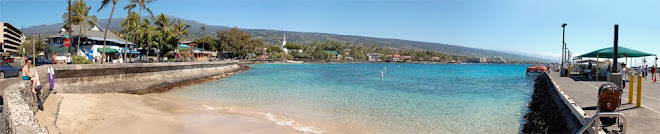
KONA TOWN

KONA TOWN
photo by EfrankE
Showing posts with label Kona. Show all posts

Tuesday, June 1, 2010

The Keauhou Store


If you look at a maps of the flatland, farming areas of the Midwest you’ll notice that towns are located an average of about 8 miles apart, sometimes a little closer or farther, but not much farther.

Towns were birthed in earlier times based on the distance a farmer could load up a wagon, hitch up his horse team and drive to town, unload his produce, buy supplies and return to his house in one day’s time. Overnight stays for farmers were often impractical for several reasons, one being the care of the livestock.

Here in Kona coffee growing country, there remain longstanding general stores at a much closer distance together, I’d say every two to three miles. They served the surrounding coffee farmers and field workers and their children. They are often located right at the old Mamalahoa highway edge of road, I’m guessing due to minimal regulation in pre-statehood Hawai’I, and as a practical response to the steep slope with rapid topographic drop-off.

These general stores resemble those of American frontier western towns of the latter half of the 19th century in that they are built of wood and often present a tall vertical facade in front of a pitched roof, usually double pitched, but sometimes a single-pitched shed roof.

I’ve driven by some of these buildings for years. Many had become quite deteriorated in appearance. Recently, restoration and refurbishment seems to be trending among at least some of the shop owners.

The Keauhou Store is one I’ve always particularly liked. The front facade features a stepped up parapet with radius corners at the height transitions, recalling the streamlining effects seen in buildings of the Art Moderne style popular, on the Mainland anyway, between the 1920’s and 1940’s.

The stepped facade follows the pitch of the roof behind with outer façade portions stretched out to emphasize horizontality (customary of A.M.) while allowing the higher central portion to create kind of a dwarf-ly “monumental” presence. This is an eclectic building. The facade above the porch roofs is smooth, as you would find characteristic of
Art Moderne examples, while the under-porch and side portions utilize the more rustic board and batten cladding.


You can see the drop-off from the road. This building is only about a mile to a mile and a half from the county’s water department offices and base yard. I suspect county water is now available. The rainwater catchment system may now serve as an irrigation source for nearby coffee trees or other farm crops.

The Keauhou store strives for a symmetry that might be more commonly seen in Neoclassical or Italian Renaissance styles, yet finally gives way to its utilitarian needs with the left side projection. In spite of its stylistic anomalies, there’s something unexplainably appealing about this building. I’m looking forward to its completed rehabilitation.

Also somewhat recently refurbished and about 7 miles northward is the K. Komo Store. The store appears to have been constructed, much like buildings going back ages, for commerce on the ground floor and the merchant’s living quarters above.

In both buildings, parking arrangements are left pretty much to the driver’s imagination. Four-wheel drive vehicles might find more parking options.

The K. Komo Store – Note the covered, raised boardwalk, another feature seen on some frontier town buildings.

Not sure the purpose of the top-forward projecting windows. Glare reduction, maybe? I believe these are a recent addition.

As always, click on any photo to view a larger image.

Sunday, May 23, 2010

10,000 Days Below the Volcano

This last week we passed the 10,000th consecutive day of volcanic activity on the Big Island. Eruption activity began January 3, 1983.

Here’s a time-elapsed clip of minor activity occurring at Halemaumau crater on a day the trade winds were blowing.
classid="clsid:D27CDB6E-AE6D-11cf-96B8-444553540000">
Video clip used with permission by EfrankE

Most of the flowing lava comes out of the side of Mauna Loa. The volcano has overlaid old lava with new, destroyed homes and forest land, closed a main road with lava and even extended the cliffs of the island a little farther out into the sea, but mostly it has produced a lot of steam and gas emissions. Note: The banner photo at the top of this page is a shot of Hualalai Mountain, a dormant volcano which separates us from the actively volcanic south-eastern part of the island.

The output of sulfur dioxide varies from 200 tons to 2,000 tons per day. It acidifies the rain, at times, to the detriment of Big Island crops. When molten lava flows into the ocean the sulfur dioxide combines with the seawater to form steam clouds of hydrochloric acid. It’s good to avoid the area on those days.

It’s always more pleasant in Kona when the trade winds are blowing, sending the vog (volcanic version of smog) southward and out into the Pacific. In the summer, Kona winds prevail much of the time and bring the vog northward along the leeward coast, spoiling otherwise pleasant views.

The long-term health effects of breathing air with a high concentration of sulfur dioxide for 27 years are still unknown, though not expected to be beneficial.

Saturday, May 15, 2010

Chinese Dogs Sent into Space for What?


In 1957, Laika the dog was launched into space orbit by the Soviets, blazing a path for human spaceflight. Today, the Chinese regularly launch dogs into space with their own astronauts.

There is a notable difference in the designated role of the dog between the two space programs. The Soviets sent Laika into orbit primarily to determine whether humans could survive weightlessness in space.

The Chinese send dogs, or as they are widely known in the western world, Man’s Best Friend, into space as part of a healthy breakfast, or whatever meal they are consumed as a menu item.

The UK Telegraph reports that Former astronaut and China’s first man in space, Yang Liwei, commander of the Shenzhou five 2003 space mission explains in his autobiography, The Nine Levels Between Heaven and Earth, “Many of my friends are curious about what we eat [in space] and think that the astronauts must have some expensive delicacies, like shark’s fin or abalone. Actually we ate quite normal food, there is no need to keep it a secret.”

One item that stands out on the listed menu of normal items includes dog meat, specifically, the type sourced in Huajiang County in Guangdong, which is esteemed in China for its nutritional benefits. Not significantly, dog shared the menu on day three of Liwei's mission with baby cuttlefish casserole and eel with green pepper.

Hope I’m not making everyone too hungry to read to the end of this post.

To capsulize, somebody in the Chinese space program made the decision that shark fin was too extravagant for space missions, but dog as a nutritious, yet familiar, comfort food would contribute to the fitness and focus of the astronauts in the performance of their mission, and that there is no need to keep this a secret. Tough call, but you gotta just trust the experts in these things.

Does this post have a point, you ask? Well, no, not a very strong one, other than, it can help make some sense of things to view people and their activities in their cultural context. That, and the term “puppy chow” might lose a lot in translation depending on how good the foreign language dictionary is that you might be relying on.

A few years ago here in Kona, while waiting to pick up baby girl from middle school, a ten or eleven year-old girl passed my car while walking her pet Vietnamese pot-bellied pig on its leash. I watched the two of them stroll down the sidewalk until they turned the corner. disappearing from sight. In some (probably only non-gated) subdivisions in Kona, domesticated pigs may be kept as pets. Doesn’t keep me from eating bacon, though.

One of my Filipino buddies here always claimed he had the best recipe for cat. He remained tight lipped about giving up the family recipe, but he did let slip that the secret lay in the ginger. I’ve never personally tasted it at any cookouts or potlucks as far as I’m aware, … maybe, though. He did mention it tasted pretty much like, what was it again? Oh, yeah, cat.

Tuesday, February 2, 2010

What in the World Happened to Wendy’s?


It’s been several years now since the Wendy’s in Keauhou closed up. It was in an accessible location, quick in-and-out service, decent amount of parking and, get this –it had a better view of the Kona Coastline than any house I’ve ever lived in!


As real estate, the location-location-location should have guaranteed success: Situated smack dab in the middle of the Keauhou Resort area, road-linked to a grocery store-anchored outdoor mall, signal lights adjacent to help get you in and out of traffic, filling station across the road. So what happened?

The story goes that the owner couldn’t find enough help to stay open. Hard to figure that in today’s economy, but who knows? During the last boom maybe there were more and better jobs available to the (mostly) teenagers who would have been logical candidates for employment at Wendy’s.

Personally, I never got used to square hamburgers, though I ate at Wendy's once in a while, until, that is, I noticed that a lot of pieces of hamburger in the chili formed right triangles.

I recalled, from the summer I worked under a professional chef in the Catskills, that in the restaurant business, profits were maximized and waste was minimized by taking older, less-appetizing food and disguising and re-using it as a component in some different dish. Translation: I always felt like I was eating old, unsold hamburgers that had been chopped up and dropped into the pot.

I don’t know if that’s what they did or not but the evidence suggested it and, well, there were other options. The closing left me with little chagrin.

There’s been a rumor circulating that Kona chef Sam Choy has plans to open a restaurant of some kind in the too-long vacant building. If so, that would be a bold move in these times and I would wish him success.

Monday, January 11, 2010

Banyans, Last Week

1-1/2 Minute long surfing highlights. Footage shot by EfrankE on January 6 & 7, Wednesday and Thursday, of last week.

Second to the last rider is Kona-grown professional surfer, Shane Dorian.

Wednesday, January 6, 2010

What, You Call This Global Warming?


This is nothing. Why back in the Little Ice Age,...


Recent national and international headlines...

Britain’s Big Snow Shuts Cities…
Cold Snap Spurs Power Rationing in China…
Winter Chill Could Be Worst in 25 Years in USA…
Midwest Sees Near-Record Lows, Snow by the Foot…
Iowa Temps ‘a Solid 30 Degrees Below Normal’…


And locally…

Mike’itect Has to Pull Sheet Over Self After Awakening to 4:00 a.m. Breeze...

That’s right, last night in bed while turning over between sleep cycles I was awakened with a start by a clearly detectable breeze passing through the bedroom, bringing an almost noticable chill to the air.

Reacting quickly to the shock with a surprisingly clear mind, my first thought was to get up to close the lanai slider, but after I thought about it more calmly, decided instead to yank a corner of the sheet away from my sleeping wife’s clutches, enough at least to cover my upper torso. This one bold act furnished me enough warmth to drift back into sound slumber until morning.

Last night's disappointing temperatures did, however, give way today to warming conditions under clear skies, and a western swell, with surfing conditions expected to improve through the weekend.

Caution remains, as disruptions do not appear to be over yet. Temperatures are expected to dip down into the upper sixties tonight, before rising to a predicted high of 81 degrees by mid-day.

Offering comfort and helping provide a solid mooring to us in the midst of continuing weather uncertainties, is the perspicacity of this young beachboy:

“The worst day eating sand at the beach is better than the best day eating snow. Anytime, anyplace.”


Kua Bay, North Kona Coast